

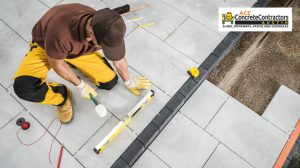
 A concrete patio is a poured, steel-reinforced slab that gives a backyard a level, permanent outdoor floor. Unlike pavers or decking, it’s one continuous piece, formed and finished on site, which is why the ground preparation under it matters as much as the concrete itself.
A concrete patio is the simplest idea in outdoor construction: a poured slab that turns part of the yard into a floor. That simplicity is why it outlasts almost everything else you could put there, and also why the differences between a good one and a bad one are invisible on day one. The concrete everyone sees is the last step. What decides how the patio ages is the grading, base, and steel underneath it, and in Austin, how all three were planned for clay soil. This guide covers what a patio actually is, the types and finishes you can order, and what to know before you have one poured. If you’re already planning one, our concrete patio service page covers our process, and we’ll take your call whenever you’re ready.
How a concrete patio differs from pavers and decks
Pavers are individual units on a sand bed; they can be lifted and relaid, and they shift individually, which is both their charm and their maintenance story. A wood or composite deck is a raised frame, right for sloped lots and second stories, with the upkeep a frame implies. A concrete patio is monolithic: one piece, poured in place, sitting directly on prepared ground. It doesn’t shift in sections and it doesn’t need boards replaced, but it can’t be taken apart either, so the decisions get made once, before the pour.
That’s also why the patio conversation in Austin starts below the surface. Our clay swells when it rains and shrinks when it doesn’t. Pavers ride that movement piece by piece; a slab has to be built so the movement doesn’t crack it, which means a compacted base, steel, and control joints planned rather than improvised.
The types of concrete patio you can order
Most patios are one of four shapes of the same idea. A standard rectangular slab off the back door is the workhorse. An extension adds new concrete to an existing slab, doweled into the old edge so the two move together; our patio extension guide covers how that’s done. A wraparound follows the house past a corner, which adds forming work and joint planning. And a multi-level patio steps down a sloped yard, each level its own small slab. Size and shape change the price less than people expect; the finish changes it more, which is covered in our patio pricing guide.
Finishes: what the surface can look like
Broom finish is the standard: the surface is dragged with a broom while green, leaving fine texture that’s slip-resistant and forgiving. It’s the finish we pour. Stamped, exposed-aggregate, salt, and colored finishes exist too; they’re specialty decorative work with their own upkeep, and while we don’t offer them, it helps to know how they compare. Our finish comparison guide compares them with photos, and our sealing decision guide covers which ones need sealing and when.
What an Austin patio needs under it
Three things, in order. Grading, so the slab falls away from the house and water never sits against the foundation. A compacted base, because concrete poured on loose fill settles with it. And steel on chairs, in the middle of the slab where it can hold a crack closed. Control joints are cut the same day as the pour, spaced for our soil, so the slab cracks in straight lines where we told it to. When one of those four is skipped, the patio still looks perfect for a season or two; the cracks that show up later are the receipt. Our guide on patio cracks explains which ones matter and which are cosmetic.
When a patio is the right call, and when it isn’t
A patio wins when the yard is reasonably level, you want a permanent surface with near-zero upkeep, and the plan includes furniture, a grill, or a future cover. A deck wins on steep slopes and raised doors. Pavers win when you know the surface will be opened up later for utilities. And sometimes the right call is fixing the slab you have: a sound patio with a tired surface can be resurfaced instead of replaced. If you’re weighing those, we’ll give you an honest read on which one your yard wants before we quote anything.