Why Austin’s Expansive Clay Breaks Concrete, and How to Build for It
- Ace Concrete Contractors Austin
- Concrete Tips & Advice
Ace Concrete Contractors Austin

Much of Austin sits on expansive clay that swells when it’s wet and shrinks when it dries, raising, dropping, and bending the concrete on top. Driveways, patios, and slabs last on clay when the ground is prepared, the base is compacted, steel sits mid-slab, and water is kept away.
If you’ve lived east of MoPac for a few summers, you’ve seen it: cracks in the driveway that open in August and close up in spring, a patio that’s tipped toward the house, a sidewalk panel standing a half-step proud of its neighbor. None of that means the concrete was bad. It means the ground under it moved, and in much of Austin, the ground moves a lot.
This guide explains what Austin’s clay is, why it behaves the way it does, and what separates concrete that survives it from concrete that doesn’t. It’s the background behind every soil sentence on our service pages.

Austin sits on the Balcones Fault Zone, and the city’s ground changes across it. West of the fault, in the hills toward the lakes, limestone sits close to the surface, and concrete built on it tends to stay put. East of the fault, the land flattens into the Blackland Prairie, where deep, dark clay soils run for miles. The most famous of them, Houston Black clay, is the official state soil of Texas, and it’s one of the most expansive soils in the country.
Most of Austin’s homes east of MoPac and along I-35, plus Pflugerville, Manor, and much of Round Rock, sit on clay like this. Our east-side neighborhood guide covers how that plays out in older homes, and the South Austin area page covers the clay pockets south of the river.
Clay is made of tiny, flat mineral particles, and in Blackland soils many of them are a type that soaks up water between its layers. When the soil gets wet, those particles swell and the ground rises. When it dries, they shrink, the ground drops, and deep cracks open in the yard. In a Central Texas year, that cycle runs hard: soaking spring rains, a long dry summer, and fall storms that start it again.
The movement isn’t even, and that’s the real problem. The ground under a sprinkler, a downspout, or a shady corner stays wetter than the ground in full sun. A big tree pulls moisture out of the soil around its roots. So one end of a driveway can rise while the other drops, and concrete, which handles squeezing well and bending poorly, cracks where the stress collects.
On driveways, the classic sign is a crack running across the slab near the garage, with panels tilting along it. On patios, it’s a slab that’s tipped toward the house or split down the middle. On walks, it’s panels that no longer line up and lips that catch a toe. Cracks that open and close with the seasons, or that are wider in August than in April, are almost always clay at work. Our post on what tear-outs usually find shows how often the real cause is a slab poured without the base that clay demands.
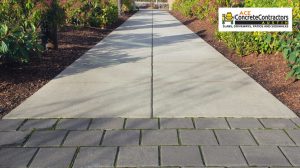
You can’t stop clay from moving, but you can build concrete that rides the movement without breaking apart. It starts below the surface. The subgrade gets prepared and moisture-conditioned so it doesn’t go in bone-dry and swell under the new slab. A gravel base goes on top, compacted in layers, to spread loads and buffer the clay’s movement. Steel sits in the middle of the slab on chairs, where it can actually hold cracks tight, instead of lying on the dirt.
Joints matter as much as anything. Control joints, cut the same day and spaced closer on clay, tell the slab where to crack so it does it in straight lines you’ll barely notice. Thickened edges help a slab resist curling at its perimeter. Thickness and steel are sized to the job, and on our quotes they’re written out line by line. For backyard pads and garages, our slab build standards page walks through the full sequence.
Since clay moves with moisture, the most useful thing a homeowner can do is keep moisture steady and away from concrete. Grade soil so it falls away from slabs. Point downspouts away from driveways and patios. Keep sprinklers off the concrete and out of the first couple of feet next to it. Fill open joints and cracks so rain doesn’t reach the base. And in a long drought, steady watering of the yard, not the slab, can keep the ground from shrinking unevenly. Our yard grading guide covers grading in more detail.