Patio Drainage and Grading in Austin Yards, Explained Properly
- Ace Concrete Contractors Austin
- Concrete Contractor Tips
Ace Concrete Contractors Austin

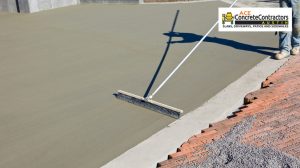 Patio drainage starts with grading: the slab is built to fall away from the house so water can’t sit against the foundation, with a modest cross-slope doing the daily work. On Austin clay the stakes double: water that lingers beside a slab moves the soil that moves the concrete.
Every patio question eventually turns into a water question. Where does rain go when it hits the slab, where does it go after that, and what’s it doing to the soil on the way? Standard practice answers all three before the concrete’s ordered, which is why grading is priced into every honest patio quote and why it’s the least visible line and the most consequential one. This guide covers how patio drainage is supposed to work, the slope logic, the add-ons that earn their cost, and the Austin-specific reason none of it is optional. The build steps around it live in our the build steps around grading guide.
A patio’s grade has a single non-negotiable job: water leaves toward the yard, never toward the foundation. The standard is a gentle fall, enough that rain sheets off without the slab reading as tilted, and it’s set in the excavation, not adjusted afterward. A slab that back-pitches toward the house delivers every storm to the foundation line, and on expansive clay that’s not a puddle problem, it’s a soil-swelling problem with the house on top of it. It’s also why extending or replacing a patio is the moment to fix inherited grading, since the dirt’s already open and the correction is nearly free compared to doing it as its own project later.
The slab sheds water; the yard has to accept it. Standard practice walks the whole path: where the patio’s runoff lands, whether the lawn carries it away or ponds it, and what the roof is contributing, because a downspout that discharges beside a patio can outdo the rain that lands on it. Yards that slope toward the house, common on cut lots, need the grade corrected in the soil before any concrete conversation, and that’s real excavation, priced as such. The test any homeowner can run is free: watch the yard during a hard rain and note where water stands ten minutes after it stops. That map is the drainage plan’s first draft.
Most patios don’t need hardware; grade and a receptive yard do the job. The exceptions are predictable. A patio between the house and a rising yard wants a channel drain along the high side, catching water before it reaches the slab. A low corner with nowhere to send water wants an area drain piped to daylight. A roofline dumping onto the patio wants gutters and extensions more than it wants anything cut into concrete. What standard practice avoids is hardware as apology: a drain installed to rescue bad grading is a pump on a leaking boat, and the honest fix was in the dirt. Where an existing slab’s drainage has already done damage, the sequence runs through our damage-first sequence before any surface conversation.

Austin’s expansive clay swells wet and shrinks dry, and a slab is along for whatever ride the moisture cycle takes. Good drainage flattens that cycle: water that leaves quickly can’t soak the soil under one edge, so the slab’s support stays even and the cracks stay inside the control joints where they belong. Bad drainage concentrates the cycle, one soaked corner, one heaved panel, and it’s the backstory of most of the patio damage covered in our the crack backstory guide. This is also why sprinklers deserve a mention no one gives them: a zone that soaks a slab edge daily is a slow-motion storm, and adjusting heads is the cheapest drainage work on this page. When you’re planning a patio and want the water thought through with it, our grading in the scope builds grading into the scope, where it belongs.