How Thick Should a Concrete Driveway Be? Thicker Isn’t the Spec
- Ace Concrete Contractors Austin
- Concrete Contractor Tips
Ace Concrete Contractors Austin

 Four inches is the standard residential driveway thickness for cars and light trucks, with thicker sections at the apron and wherever heavy vehicles park. Past that, base compaction and steel placement prevent more cracking than added inches do, which is why thickness alone never tells you a driveway’s quality.
Thickness is the spec homeowners ask about because it’s the one that fits in a sentence, and it’s a fine question as long as the answer includes what thickness can’t do, which is most of what people assume it does. An extra inch of concrete over a loose base is an extra inch of concrete that cracks. Here’s how thickness actually gets chosen, where the driveway genuinely should be thicker, and the two specs that outrank it. The full driveway decision lives in our full driveway decision, and every number here should appear in writing on any quote you sign, ours included, which our written spec standard page explains.
Four inches of reinforced concrete over a compacted base is the residential standard, and it handles what a household parks: cars, SUVs, light trucks. That’s not a minimum to negotiate down from; thinner slabs are where builder-grade driveways came from, and replacing those is steady work for us, which is its own kind of testimonial for the standard. Uniformity matters as much as the number, since a slab that’s four inches at the crown and two at a lazy edge cracks at the lie, and uniform thickness is a grading achievement, earned in the excavation before the truck ever arrives.
The apron, where the driveway meets the street, takes turning loads and delivery trucks and earns extra thickness. So does any run where something heavy lives: an RV pad, a boat trailer’s parking spot, the path a future contractor’s loaded truck will take to a backyard project. Thickened edges, where the slab deepens along its perimeter, keep corners from snapping under point loads and cost little at pour time. Tell your contractor what will ever park there, including the once-a-year things, because the spec should be built for your worst Tuesday.
Base compaction and steel placement. A compacted gravel base spreads load and keeps the slab uniformly supported, which is most of crack prevention on Austin clay; steel on chairs mid-slab holds tight whatever cracking still comes. [CONFIRM process observation: e.g., what the crew finds under the failed builder driveways they tear out, and how often thickness was even the problem.] A five-inch quote with no base line and mesh ‘pulled up’ during the pour is a worse driveway than a four-inch quote with compaction in lifts and rebar on chairs, and it usually costs more.
The spec should read like this: thickness for the main run, a thicker figure for the apron and any heavy-load zones, base material and compacted depth, steel type and spacing, and joint layout; if it doesn’t, it isn’t a spec, it’s a price. If a quote gives you one proud number and silence around it, the silence is the answer. Thickness questions also connect to timing, since deeper slabs and their bases mean more excavation, covered honestly in our excavation and price, and to patience, since our first-week patience guide explains why even the right thickness needs its first week respected.
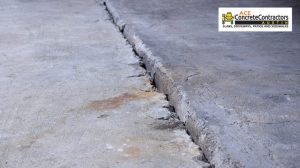
Adding thickness adds depth in the ground, not height above it, since the finished driveway still has to meet the garage floor and the street. A five-inch slab means an inch more excavation across every foot, plus the base under it, which is why thickness changes show up in the site-work lines of a quote as much as in the concrete line. It’s also why deciding thickness after the excavation is done is expensive in the wrong direction. This is the practical reason we ask the what-will-ever-park-here question at the measuring visit rather than at the pour: the answer sets the digging, the digging sets the schedule, And the schedule’s already in motion by the time most people remember the boat, which is our polite way of saying: walk the property and inventory everything with wheels before the measuring visit, because the cheapest thickness change is the one made on paper.