
How Much Does a Concrete Slab Cost in Austin?
A concrete slab in Austin, TX is priced by what it carries, which sets thickness and steel, then by size, base and grading, and truck access. A 12×12 shed pad and a 12×12 hot tub pad can cost very differently.
People search for the cost of a 12×12 slab because that’s a common shed size, and the honest answer is that 12×12 tells us the area but not the price. What sits on the slab decides the thickness and the steel, and those decide more of the number than the square footage does. This guide explains each factor, answers the 12×12 question properly, and shows what an itemized slab quote should contain. If you have a building on order, send us the dimensions with the dimensions and we’ll price the pad.
We don’t publish a per-square-foot figure for slabs, because a shed pad and a garage floor of the same area are different jobs. What’s stable is the list of things that move the price and their order. For how a slab actually gets poured, our concrete slabs page covers grading through finish.

What the slab carries sets the spec
A shed with garden tools in it, a workshop with a lathe, a two-car garage, and a filled hot tub each ask something different of the slab. Load sets thickness, and it sets the steel: a light shed pad at four inches with a rebar grid is the simple case; a garage or heavy workshop pad wants more thickness, thickened edges, and a heavier grid. Tell us what’s going on the slab and we’ll write the spec into the quote so you can check it against your building supplier’s requirements.
Enclosed slabs, which is most workshops and garages, also get a vapor barrier under the concrete, and some get a floor drain or a sloped section. Those are small lines but they belong on the quote. Our how a slab is poured guide walks through the whole sequence if you want to see where each item fits.
So what does a 12x12 slab cost?
For a 12×12 pad, the area is small enough that the fixed parts of the job, meaning the crew’s day, delivery, forms, and setup, are a large share of the price, and the concrete itself is a smaller share than people expect. That’s why a 12×12 and a 16×16 shed pad are closer in price than the square footage suggests, and why pouring a slab and a walkway or patio pour in the same visit is cheaper than two visits.
Within the 12×12 size, what moves the number is load (shed versus hot tub), site prep (flat and clear versus sloped and rooty), and access (truck to the site versus wheelbarrows through a gate). Send us those three things and the answer stops being a range.
Base, grading, and the ground under it
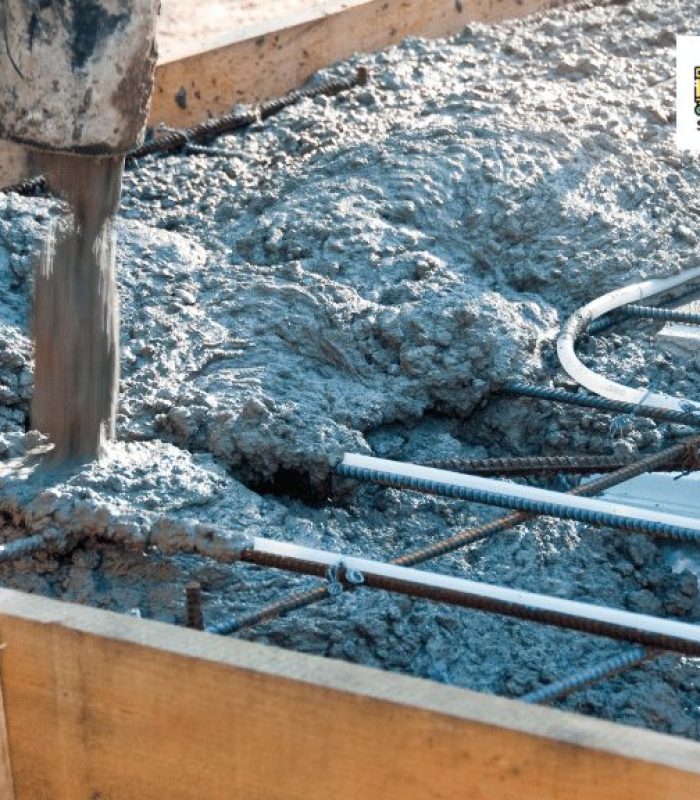
Every slab we pour goes on a compacted gravel base over a prepared subgrade, and the base is priced as its own line. A flat lot with the topsoil stripped is the simple case. A sloped site means a cut on one side and compacted fill on the other, and the fill side is where hillside slabs fail if it’s skipped. Rock, common west and north of Austin, slows the excavation. Clay, common everywhere else, means wetting and recompacting the subgrade before the gravel goes in, which makes more difference than an extra inch of concrete.
Removing an old slab or a pile of fill, rerouting a sprinkler line, and dealing with a tree root each add a line. So does an HOA or city review if the building on the slab triggers one; we’re your permit partners on that, coordinating the paperwork through a permitting partner when the filing needs one, and we list the handling separately.
Access, extras, and how the quote is built
Slabs often go in the back corner of a lot, which is the farthest point from where a mixer can park. Pumping or wheeling concrete adds labor, and a fence panel that has to come down and go back up adds time. It’s the most common reason a slab quote is higher than the homeowner expected.
A quote worth signing lists dimensions, what the slab is for, thickness, thickened edges if any, steel type and spacing, vapor barrier, base depth, grading and site prep items, access method, and extras. Ask every contractor for that list; it’s the standard we hold our own quotes to. Two slab quotes that differ by a lot usually differ on thickness and steel, or one of them has no base line. The same logic applies to walks, which we cover in our sidewalk cost guide. If the slab is failing rather than new, our sunken slab repair page covers when section replacement beats a full re-pour.
Questions we get about slab pricing
Does a 12x12 concrete slab cost less than a 16x16?
Yes, but not by as much as the square footage suggests. Setup, delivery, and the crew’s day are shared across the pour, so the concrete is a smaller share of a small slab’s price. If you’re choosing between sizes, the larger one is usually the better value per foot, and it’s cheaper to pour it right the first time than to extend later.
How much does a concrete slab cost per square foot in Austin?
We don’t publish one, because a shed pad and a garage floor of the same size are different jobs with different thickness and steel. Access and site prep move the number too. Tell us the dimensions, what’s going on the slab, and where it sits on the lot, and you’ll get an itemized quote instead of a guess.
Is a thicker slab worth the extra cost?
For a garage, workshop with heavy equipment, or hot tub, yes: thickness and thickened edges are what keep corners from lifting and the slab from cracking under point loads. For a garden shed, four inches with steel is enough, and the money is better spent on base compaction, which prevents more problems than extra concrete does.
Do you charge more for a slab on a sloped lot?
Yes, because the low side has to be filled and compacted in lifts, and sometimes the high side needs a cut or a short retaining edge. The cost is in the earthwork, not the concrete. Skipping the compaction is how hillside slabs end up tilted, so it’s not a line we’ll leave out to hit a number.
Does the price include a foundation for a house or addition?
No. We pour slabs for sheds, garages, workshops, carports, and pads, not house foundations, which are a separate trade with an engineer’s design. If your project is an addition or a home, we’ll tell you so and describe the kind of firm to call rather than quote it ourselves.
Have a building on order and need to know what the pad will run? Call (512) 566-7530 or send the form below with dimensions and what’s going on the slab. We’ll confirm thickness and steel in writing and give you an itemized number.