How Much Do Concrete Sidewalks Cost in Austin?
- Ace Concrete Contractors Austin
- Concrete Contractor Tips
Ace Concrete Contractors Austin

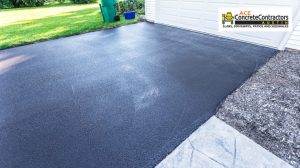 A concrete sidewalk in Austin, TX is priced by length and width, any demolition, public-panel status (city and ADA specs), the ground and roots under it, and the finish. Public panels cost more than private walks of the same size.
Sidewalks come in two kinds for pricing purposes: a private walkway in your yard, and a public sidewalk panel in front of your house that the city has flagged. They’re built the same way, but the public one has to meet city specs for width, thickness, and slope, and that changes the job. This guide covers what sets the cost of each, in order, and what an itemized quote should show. If you’ve got a flagged panel or a walk to pour, send us a photo and length and we’ll price it.
We don’t publish a per-linear-foot number, because a garden path and a city-spec panel replacement over a tree root aren’t the same job. What holds is the list of factors and their order. For how the walk gets built, our concrete sidewalks page covers layout through finish.
Length is the obvious factor, and width matters more on sidewalks than people expect, because a walk that’s a foot wider is a third more concrete on a three-foot path. Standard front walks run three to four feet wide; public panels have to match the existing sidewalk width, which is set by the city. As with any pour, the cost per foot drops with length because setup and delivery are shared.
Curves, steps, and landings add forming time. A walk that connects to a backyard patio or a driveway should be poured in the same visit when possible, both because the finishes match and because one mobilization costs less than two.
Removing an old walk is a separate line: breaking, loading, and hauling concrete, then dealing with whatever’s underneath. On older walks that’s often nothing, which means a new base has to go in. Tree roots are the sidewalk-specific problem: a root that lifted the old panel is still there, and the choices are cutting it (which the city regulates for street trees), bridging it, or rerouting the walk. On central Austin panels the street-tree root usually can’t be cut under city rules, and the panel is poured over a bridged section instead.
Base and grading follow the same rules as any slab: strip, grade with a slight cross-slope so water runs off, and compact gravel. On clay, closer joint spacing costs a little more forming time and prevents most of the heaving that brings us back.
A flagged public panel has to be rebuilt to the City of Austin’s standard for thickness, width, and running and cross-slope, and if the panel includes a curb ramp, to ADA ramp requirements as well. That’s more concrete and more care in forming than a private walk, and it may involve the city’s right-of-way process. We’re your permit partners: we know the spec, we’ll tell you what your panel triggers, we’ll coordinate the paperwork through a permitting partner when the filing needs one, and we list the handling as its own line rather than hiding it in the total.
HOA common-area walks sit in between: no city inspection, but an HOA spec to meet and usually a schedule to work around. Our sidewalk defects guide covers the defects the city and HOAs look for, which is useful if you’re deciding whether a panel needs replacing or just grinding.
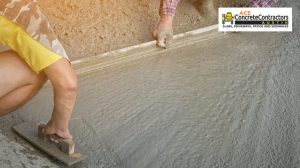
Broom finish is standard for sidewalks: it’s what the city requires on public panels, and it’s what we pour on private walks too. Extras that show up: a step or landing, a drainage channel, re-sodding the edges, and rerouting a sprinkler line. Grinding a raised joint instead of replacing a panel is the cheapest fix when the lift is small, and our trip hazard grinding page covers when that’s allowed. Extras that show up on public work, like re-striping a curb ramp, we list separately.
A quote worth signing lists length, width, thickness, base depth, steel, joint spacing, demolition and haul-off, root handling, city or HOA spec items, access, and finish. Ask any contractor for the same breakdown; it’s the standard we hold our own quotes to. If two sidewalk quotes differ by a lot, look at the demolition line and whether the base and steel are there at all. The same test works on pads, which our slab cost guide covers.