How Much Does a Concrete Patio Cost in Austin?
- Ace Concrete Contractors Austin
- Concrete Contractor Tips
Ace Concrete Contractors Austin

A concrete patio in Austin, TX is priced by its size, the finish you choose, new pour or extension of an existing slab, the site prep the lot needs, and truck access. After size, finish moves the number most.
Patios are the project where the ground decides the price more than the concrete does. A broom-finished slab on a flat, open yard and the same slab on a slope behind a narrow gate are very different jobs, and that gap is often bigger than the gap between a small patio and a large one. This guide goes through what sets a patio’s cost in the order it matters, then explains what an itemized quote should show. If you already know the size and finish you want, send us the size and finish and we’ll price it.
We don’t publish a per-square-foot number, because it’d be right for one finish and wrong for the rest, and it’d be out of date by next season. What stays true is which factors move the price and by roughly how much relative to each other. That’s what’s below. For how the patio gets built, our concrete patios page covers the pour from grading to finish.
Size is the starting point, and as with any slab the cost per foot drops as the patio gets bigger, because setup and delivery are spread across more concrete. Shape matters more on patios than on driveways: curves, multiple levels, and cutouts around trees or posts add forming time and waste. A simple rectangle is the cheapest shape per foot, and a patio that meets the house along a straight line is easier to form than one that wraps a corner.
Thickness is mostly fixed at four inches for a patio that carries furniture and people, so it’s rarely a price lever. The exceptions are a hot tub, an outdoor kitchen with a masonry base, or a pergola with posts on the slab, which each want a thicker section or footings and add to the quote.
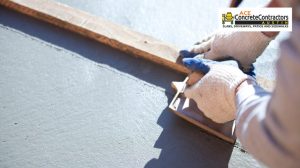
Every patio we pour gets a broom finish: it grips when wet, hides small imperfections, and needs no sealing schedule, so finish isn’t a line that moves our price. Stamped, exposed-aggregate, and colored finishes are specialty decorative work we don’t offer; our patio finish guide explains what they involve if you’re weighing them.
One thing we tell every client: shape costs more than people expect. Curves, inside corners, and extra levels add forming time, so a clean rectangle sized to the furniture usually gets more patio for the money than a complicated outline.
Extending an existing patio is usually cheaper than pouring a new one of the same added size, because part of the forming is already there and there’s no full excavation. It’s more expensive if the existing slab has heaved and needs a section replaced first, and we won’t tie a new extension to a moving slab. Our slab repair page covers what that fix looks like.
Site prep is where the surprises live. A flat backyard with good drainage needs stripping, grading, and a compacted base. A yard that slopes toward the house needs the grade corrected so the patio drains away from the foundation, and that’s real excavation. [CONFIRM process observation: e.g., on a lot of the older lots we see, the yard was graded toward the house when the patio was poured, and fixing that is the most important part of the job.] Tree roots, an old slab to remove, and a sprinkler system to reroute each add a line.
Backyard patios are often the hardest thing we pour to reach. If the mixer can’t get near the site, the concrete gets pumped or wheeled through a gate, and that adds labor. A narrow side yard, a fence that has to come down, or steps between the driveway and the yard all show up on the quote. Extras that commonly appear: a step down from the door, a drainage channel, footings for a pergola, and permit handling if the patio changes impervious cover.
Our quotes list square footage, shape notes, thickness, base depth, steel, finish as its own line, site prep items, access method, and extras. That’s the format to ask any contractor for. If two quotes differ, look first at the finish line and the site prep line; those two carry most of the variation on patios. Timing helps a little too: a winter or early spring pour in Central Texas often books faster and quotes tighter than one in June. For comparison, and covered in our driveway cost guide, a driveway is priced on tear-out and load where a patio is priced on finish; a slab for a shed of the same size is a simpler and cheaper pour because it has no finish decisions.